OUR RATING SYSTEM
(*****) = do NOT miss! This one is as good as they come.
(****) = Fantastic - It's worth the price of the ticket (and then some).
(***) = Average - Nothing really bad, nothing really spectacular...
(**) = Perhaps you should find another movie to see.
(*) =
The bottom of the barrel. It would be hard to find something less entertaining or more unworthy of your time.


Maureen
(Mo) holds a PhD in marine geophysics (Dr. Maureen, to you) and works for the U.S. Geological Survey in Santa Cruz, CA. Maureen enjoys the outdoors (skiing, swimming, hiking, camping), dogs, cooking, singing, getting into (and out of) uncomfortable situations, and most importantly, watching quality movies. She makes a point of seeing as many Oscar-nominated films as possible each year and (correctly) predicting the winners. Her role on this blog is primarily as an advisor, collaborator, and "chime in"-er.

John (Jo) holds a Bachelor's Degree in Nursing, as well as a Bachelor of Arts degree in Film Studies. He currently lives in Chicago, Illinois and works as a nurse. His one true obsession in life is movies... The good, the bad, and everything in between. Other than that, he is busy caring for his cat, painting, writing, exploring Chicago, and debating on whether or not to worship Tilda Swinton as a deity. John is the master and commander and primary author of this blog.

Friday, July 21, 2017

Dunkirk (****)

DUNKIRK is the latest from Christopher Nolan, whose films had been progressively getting bigger and more ambitious over the years. From The Dark Knight to Inception and finally Interstellar, here is a change of pace for the famed filmmaker: a somewhat contained historical thriller about the evacuation of Dunkirk amidst the chaos of World War II. I admire him for the subject matter, said to be a passion project of his for years now. I recognize the structure used and the way Nolan decided to tell this story. It's a vivid piece of filmmaking, but it's nowhere near his best work.

The story is told in three distinct sections, titled "The Mole," "The Sea," and "The Air." Each tells a unique story revolving around fictional characters and their wartime efforts. "The Mole" spans one week, "Sea" one day, and "air" one hour. The intercutting between these sections and the paths they take and intersect is a risky move for such an established genre. "Saving Private Ryan" isn't known for it's complex structure - it lets the action speak for itself. We get to know our characters. We feel the chaos of war. The other thing Nolan does is introduce us to these characters without names or backstory. They are just one of the thousands of faces we see on screen. The story being told isn't a hero returning to his wife, it's the safe evacuation of 400,000 soldiers.

The majority of screen time seems focused on the new, wonderful actor named Fionn Whitehead, a young boy who dodges bullets in the opening scene and then concocts an impromptu scheme to pose as a medic in order to be evacuated on the nearest ferry via a long and damaged causeway - "the mole." Despite their efforts, torpedoes and airstrikes keep the men on stranded on the beach. In an array of explosions, sand, and bodies, these men have no where to go.

We also meet a character played by Mark Rylance who is a civilian recruited to bring his boat out to rescue the stranded men across the sea. Rylance all but steals the movie here. He brings his two sons who offer their help when they come across a stranded Cillian Murphy at sea. Rylance recognized the signs of shell shock and tells his boys "he may never be the same again." Out of all the characters in the movie, his is the only one who seems confident in his abilities to lead. He's wonderful. The third act "the air," follows Tom Hardy as a pilot tasked with defending the beach. Not only does his plane get shot and damaged by enemy fire, but his fuel tank is slowly dwindling away...

"Dunkirk" is beautifully-shot and scored (Hans Zimmer, of course) who uses the repeated sounds of a ticking clock to help amp up the suspense throughout the film. In fact the whole film feels like rising action without a break. At barely 100 minutes, this is surely one of Nolan's shortest films, but we appreciate it's time given the intensity of the situations we find these men in. Even at this length, I found myself becoming tired by the suspense, almost wanting a moment of quietness in which characters discuss what the plan is or where they are from. I suppose that's too cliche in a film that takes so many risks. In fact, there is almost an entire lack of dialogue. All story is told through action, words are inconsequential. Compared to Nolan's wordy "Inception" that was chock full of riddles and exposition, the silence of "Dunkirk" was both jaw-dropping and absolutely inspired.

Overall, I would say that Nolan has more accomplished pieces of filmmaking out there. This movie, as good as it is, still falls victim to a variety of cliches that took me out of the picture. There's an accident on Rylance's boat midway through the movie that tries to become some sort of moral quandry but neither the characters or the script devotes enough time to the real implications. It's over the top and almost unbelievable. Also, the final scenes of Tom Hardy's Spitfire (after his fuel is depleted) has moments of beauty but still feels like an unnecessary addition to a film that is overall so grounded in reality. I know the opening titles tell us that the soldiers were hoping for a miracle. I just don't think Christopher Nolan needs to spell it out so plainly for us.

Thursday, July 20, 2017

Valerian and the City of A Thousand Planets (***)

VALERIAN has apparently been a passion project for Luc Besson ever since he directed "The Fifth Element." A lot of the same elements are there, and we have a clear visual style that is evidence of the director's love of sci-fi. In fact, we can see this movie drawing inspiration from many sources. It's quite a beautiful movie I will admit. The CGI is beautiful and the sets are impressive. Why did this movie fall flat for me? Every character is a dud.

The story is inspired by a famous French comic book in which Agent Valerian (Dane DeHaan) and Laureline (Cara Delevingne) work to fight crime a couple hundred years in the future. In fact, we know this is the future though a fun opening sequence in which we watch the International Space Station merge with China. Over the years it continues to grow until alien races eventually show up and join on, too. Eventually we are left with a space station that is like a futuristic New York City: a blend of culture and races and technology, floating in space as a meeting point for all the universe's planets. Valerian and Laureline are just small pegs in a massive puzzle. They work for a human-based organization and act as rogue agents that seek justice in a morally gray area.

The basic story is that of an ancient alien race that was all but wiped out during a large space battle years ago. They lived on beautiful beaches and harvested pearls from the ocean. A few of them escaped the planet's destruction and found their way to the Big City. I suppose it's kind of a mystery movie in the way Valerian stumbles onto the major conspiracy here. At first he has a dream of the planet's destruction, but eventually he begins to think it actually happened.

VALERIAN is an unapologetically colorful movie full of a dynamic blend of aliens, sets, and costumes. We can feel the filmmaker's love for this project and at times can feel the weight of it's over-saturation. Even if it goes against the story at hand, the movie is so crammed full of aliens and sets just as a means to show off, it eventually becomes like a sugar rush that began to hurt my head. The plot is surprisingly similar to Jame's Cameron's "Avatar" in that a government agency seeks to annihilate a primitive alien race for their own benefit. That movie was beautiful as well, filled with impressive CGI and characters. There, we could understand the world of Pandora and it's story. Here, it's a constant barrage of new sets and people. It's hard to keep up.

And the characters, oh boy. DeHaan as Valerian plays the role just as Keanu Reeves might in any 1990's action movie. He even gets the voice down. He flirts with Laureline and asks her to marry him, to which she refuses. The romance between them is a constant reference throughout the film as a means of building their characters, but never once do we believe that these two even like each other past some sort of mutual respect. Valerian later runs into a shapeshifter named Bubble (Rihanna) who fills the role of sacrificial friend that saves the day. It's a fun character idea but hampered by a stilted Rihanna performance that will not go down in history as a "memorable" movie death. Then there's the General (Clive Owen) who is the cliched leader without emotion and a thirst for destruction.

I saw the movie in 3D and was amazed by the details of this world. There are great sequences of action and technology (a heist scene in which Valerian goes to a Virtual Marketplace to stop a criminal exchange is both wonderful and intriguing) and yet I left the movie feeling like I had watched something so artificial. There isn't a character here we care for nor a set piece that brings genuine suspense or tension. As realistic as the movie looks at times, we always know that most of what we are seeing is 'fake.' There aren't any real repercussions at play. Even if there were, would we even care? This is a movie that would work just as well on mute. It's gorgeous, but there's not much more to get out of it.

The Little Hours (****)

Putting aside the occasional crass humor and determined levels of shock value, there is so much to laugh at in THE LITTLE HOURS. From the cast to the situational humor drawing inspiration from the stories of Giovanni Boccaccio, this is a type of comedy we don't see often. I might compare it to something like Monty Python's "Holy Grail" although the two films have rudimental differences. Each is for a different time, a different audience. Where Monty Python found humor in breaking the 4th wall, here we are treated to swear words and sex jokes. Is anyone to say which is more universally funny?

The plot is surprisingly clear and well-crafted. We meet a group of nuns at a secluded cloister, headed by Sister Marea (Molly Shannon). The head priest here, Father Tommasso (John C. Reilly), brings the nuns' handiwork to town to sell as a means of income. Meanwhile we meet Alessandra (Alison Brie), Giverva (Kate Micucci) and Fernanda (Aubrey Plaza), three novices who will soon pledge their vows to God but still find time to belittle the convent's gardener (he talks too much, and he's probably a Jew).

In a nearby castle, a nobleman named Bruno (Nick Offerman) discovers his wife has been sleeping with one of their servants, Massetto (Dave Franco) and seeks to put him to death. There's a very funny sequence in which Lord Bruno cuts off a piece of Massetto's hair while he sleeps in hopes of catching him in the morning, and another as Bruno and his wife have an awkward breakfast conversation the day after. Massetto escapes and fatefully runs into Father Tommasso and seeks refuge. Tommasso offers Massetto a place at the convent as a gardener, but he agrees to act as a deaf mute in order to satisfy the sister's request for a "less chatty" helper. The cast is surely the best comedic lineup I've seen in a while, and each person brings their a-game. When Fred Armisen arrives to tour the convent as the Bishop, we laugh at how silly he looks in official robes. Then he talks, and we laugh at that, too. These are great comedians doing their thing.

The first scenes of the movie begin with our three novices wandering in the field, roaming the lands, having a normal discussion as one might in 2017. They swear and use expletives and threaten violence when anyone crosses their path. At first I believed that the movie was going to only rely on this novelty for laughs: the image of nuns using the "f" word. Luckily there was so much more than that. The three women quickly begin falling for Massetto and his good looks. They begin to question their devotions to God and instead enlist the help of a local witch to help seduce the man for themselves. They sneak into each other's room at night and get drunk off of stolen altar wine. At the same time we see the Father and Massetto doing the same thing over dinner.

The trailer heaped praise upon a Catholic film critic's review of the film as being "pure trash." The audience laughed when it was shown. I can't blame them. The movie carries a hard R rating that would appear to deface Catholicism if it wasn't so silly. This isn't a movie about holy people, nor is it meant to be a movie that points fingers at organized religions. None of our characters are good people, they are simply human beings living in a world that demands much more of them. What I found so funny was the setting, a novel idea for a comedy released in this day and age. It's a refreshing movie that is straight-forward and chock full of humor and wit.

Saturday, July 15, 2017

The Big Sick (**)

THE BIG SICK currently has a 97% approval rating among mainstream critics and an IMDB score flirting with the top 250 movies of all time. What movie did those guys see? I entered "Sick" with the highest of expectations and left with the groaniest of groans. What had I just wasted 2 hours of my life on? Sure, it has funny bits and the plot is relatively original. Piece by piece, it's not hard to dismantle, and such my poor review flies in the face of so many 'positive' ones, let me spell out my reasons why.

1. The romance. 
This is a romantic comedy. No denying. We have a modern-day meet cute in which Kumail (Kumail Nanjiani) meets a girl named Emily (Zoe Kazan) at his comedy show. She heckles him during a bit, and then afterwards they have a couple drinks and hook up. (It's modern-day because he's an Uber driver and eventually courts her home after the sex... Via uber app, of course). They begin a running gag in which they pledge never to see each other again, but time and again they meet up to watch B-horror movies and sleep together, and from there are planted the seeds of romance.

Nanjiani (who also wrote the screenplay based on his real-life romance with his wife) faces backlash from his Pakistani family over his requirements to marry a Muslim woman. Scene after scene his mother introduces him to women to whom he might betroth... And time and again he returns to Emily. It would be romantic if not for the actors total lack of chemistry. Kazan as Emily is a wild-type blonde who flaunts the screen and commits nothing to character. Nanjiani is the unexpected romantic lead with some solid acting chops but a lack of simple charm that the performance needs. If Kumail and Emily met in real life (as the screenplay suggests), it was not based on this type of romance. It's a completely flat and unemotional romance that blossoms too soon and then ends abruptly when Emily finds out that Kumail hasn't told his parents about her. As we have learned, she's a psychology major. "I'm surprised you aren't taking this better." Kazan overacts in a scene of bizarre emotion and ends the relationship with as much surprise as it began.

2. The setup. 
The move is called "The Big Sick" for a reason. Emily contracts a mysterious bacterial infection that leads her to a coma, and since Kumail is her most recent boyfriend, he is called on by friends to sign papers and inform the parents. Here begins the film's most interesting section. Mom (Holly Hunter) and dad (Ray Romano) are called in from North Carolina and they begin the process of not only aiding their dying daughter but also getting to know the ex-boyfriend... Who's Muslim... Who has no promising job. This is comedy gold.

I'll be the first to admit that Hunter and Romano are strange and yet inspired choices for their parts. Hunter is a southern woman more devoted to her daughter's health than her own mental sanity, and Romano is a man just trying to edge by without causing problems. The movie is much more entertaining here, and we wonder what kind of awkward situations they might find themselves in. However, we are met with forced scenes in which Holly gets too drunk and (against character) starts a bar fight with a frat boy at a comedy show, and Ray tells Kumail about a time he had an affair. Wow.

3. The payoff. 

Emily eventually recovers and Kumail is shocked to discover she still doesn't want him. He and his comedian buddies pledge a move to New York City in which they hope to jumpstart their careers. Despite the close relationships Kumail formed with her parents, it's clear that all good things must come to and end.

The movie ends happy (it's a true story afterall) but I wasn't left with anything more than an off taste in my mouth. Produced by Judd Apatow, here is yet another of his comedies that runs 30 minutes too long and about 50 jokes past "WE GET IT!" There are genuinely funny parts here, and then there are genuinely ingenuine moments, too. Nanjiani is a talented scriptwriter (along with his wife, Emily), but the movie fails at a prime level for lack of on-screen chemistry and convincing leads. Kazan especially is a woman acting out of her league, giving us a female lead that is both annoying and not missed when she is in a coma.

The Pakistani humor is hilarious, as is Kumail's relationship with his brother, but the film's conclusion sees him banished from the family for dating a white woman and then the resolution is scraped too thin if that. Are we meant to believe that he simply severed ties with his mother and father without so much as a tear shed? Yes, it might be a true story, but where's the cinematic drama? I'm not one to vouch for movie cliches, but when a movie is based on a true story, perhaps now and again a simple cinematic flourish wouldn't hurt. The movie has it's moments, but it sums up as being a "Big Stink."

Friday, July 14, 2017

The Agony and the Ecstasy (1965) (****)

THE AGONY AND THE ECSTASY is a massive story that essentially whittles down to two men and their stubbornness in believing that the other is wrong. In the grandness of the Sistine Chapel and the creation of perhaps the most famous ceiling in history, we find ourselves charmed by a story that is very small and intimate in its final message. Creation versus destruction. Knowledge versus ignorance. Man versus God.

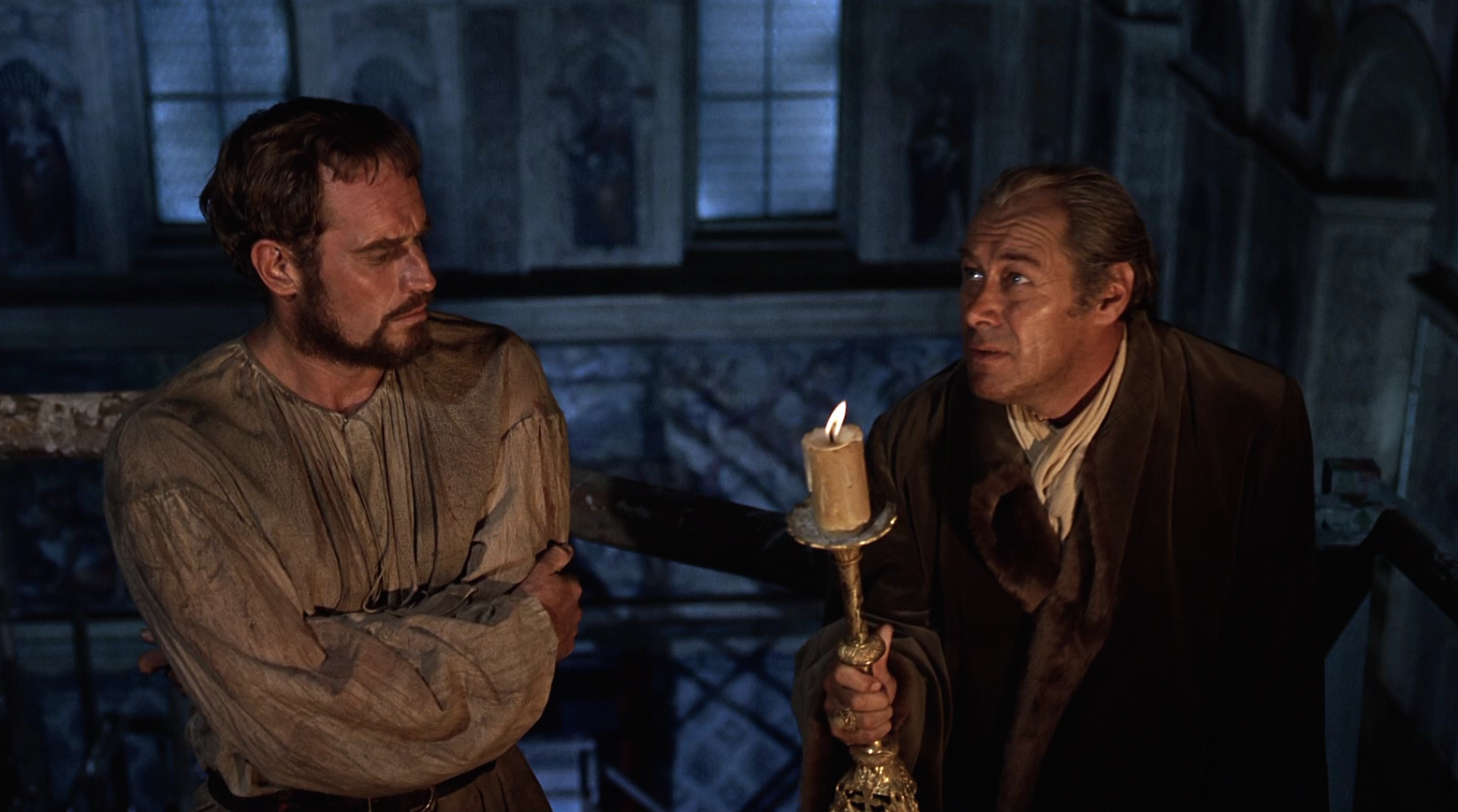
The movie was Hollywood's reaction to Irving Stone's successful biography which was written in 1961. The book, as I recall, dives deeper into the life of Michelangelo, the sculptor from Florence who was steadfast in his ways and always eager for work. As a man of the time, it seems like Michelangelo was about as famous as one could be. The film wisely closes in on his most ambitious work: the Sistine Chapel, and the period of time from Pope Julius II (Rex Harrison) commissioning the work to it's debut 4 years later.

We know that Michelangelo was renowned for his marble sculptures. The film opens with a 10-minute summary of his work: a quaint narrated piece that shows us the master's style, his vision. Nude bodies that are twisted with muscle, emotional faces that seem perfectly lifelike. The feature film devotes barely a scene to the man chiseling away at stone. This prologue of sorts helps us see who the artist was. As if to further drive home the point - we learn nothing about Michelangelo's history with fresco paintings and oil panels. He painted several throughout his life, but the film might have us believe that the ceiling was the first time he laid down paint with brush.

Our director is Carol Reed, the man probably most known for films like "The Third Man," "Oliver!," and "The Fallen Idol." Here is a more impressive undertaking for any filmmaker. For a Hollywood project, the film immerses itself in the history of Italy, and it's clear that locations were indeed in the real deal (apparently they filmed on the same marble quarries where Michelangelo really worked). Vatican City is depicted mostly through matte paintings and stages, and we see the slow development of the Church as visually indicated by St Peters in the background, slowly being built up brick by brick throughout the film.

Charlton Heston was allegedly cast in the film due to his crooked nose that was shared with the real man. Perhaps it's just a small coincidence that Heston was also cast as Moses in "The Ten Commandments" based on his uncanny resemblance to Michelangelo's carving of the biblical figure. He plays the role with a lack of humor and steadfast dedication to his work. We believe him as the artist, though his presence in the film is nothing more than a requirement. Much of his personal life is glossed over, save for a few scenes of required romantic frustrations with Contessina (Diane Cilento), the daughter of one of his Medici patrons. The controversy of Michelangelo's homosexuality (as explored more in the novel) is reduced to a few longing glances by one of Michelangelo's apprentices. At the film's conclusion when the crowd is looking at the ceiling, we see Michelangelo's assistant only looking at him.

The highlight of this film is the performance of Rex Harrison, fresh off his Oscar-winning role in"My Fair Lady." Playing the man known as the Warrior Pope, he is introduced first as a general that slashes at the enemy with sword in hand. After a grueling battle, he dons the papal robes and offers a blessing. Julius is a man who is both vein and yet understanding of the importance of art. Like Michelangelo, he too seemed to believe a divine intervention in the creation of the ceiling. No one but Michelangelo was meant to paint it. It would be the Pope's claim to fame that he was the one who initially commissioned it. When these two men bicker, we laugh at the strength in the writing. No one is wrong, but we see where each is coming from. Of course we remember the film's most famous exchange when Julius pesters Michelangelo about his slow progress. "When will you make an end?" "When I am finished!"

Another remarkable feat is the production team, laboriously recreating the Sistine Chapel to size on a studio set. It has got to be one of the most impressive feats of movie-making, all the more impressive in that I had assumed they filmed in a real chapel somewhere. When the ceiling is done, set decorators took life-sized photographs of the ceiling and attached them to the roof. The illusion is somewhat ruined when the climax shows his finished work as dark, cracked, and faded from hundreds of years of wear. Of course the ceiling was later restored to it's original glory in the 1990's. Nonetheless, an impressive camera tilt slowly rises as Pope Julius blesses the painting, slowly tilting up and up until we see the entire painting in one continuous shot.

The movie has aged slightly, some performances are now a bit over the top. What remains is the power of two actors in their prime going toe to toe, recreating a period in history that most wouldn't think about. When you walk through the Sistine Chapel today, it's an awe-inspiring thing to behold, but even then we are detached from history and the 500-year old saga that occurred to bring it to being. There's something special about watching a movie about creation and the process that goes into a man's work. For that, this is still a very special film.