MUDBOUND, based on the 2008 book by Hillary Jordan, is a movie that needed to walk a razor's edge in its handling. Movies about the racially-charged 1940's south aren't necessarily niche storytelling, but for it to work, we need to see that it is a movie that is showing us something we have never seen before. Frankly, I feel like I've seen most of this film before.
The story is focused on two families, one white family that moves to a rundown Mississippi farm to start over, and one family that works the land since slave times. Where one family is freshly planted, the other has its roots in the ground, in the town, in history. The white woman, Laura (Carey Mulligan) just wants to be a stay at home mom who cooks and cleans, but her husband Henry (Jason Clarke) has grand visions to raise crops and whatnot alongside his racist father (Jonathan Banks).
The flipside is a story of a mother named Florence (Mary J Blige) raising a wide range of children alongside her husband (Rob Morgan). Their son, played by Jason Mitchell, goes off to fight in World War II. This family lives in a rundown shack, working these dried up fields, trying to make a living. The story is less about a plot as it is about building up the sense of place. As Laura says, "I dream in brown. All I remember is the mud." That's for sure. This is a good looking and yet dreary place, photographed in pitch dark and then drenched in dirty water and overcast skies.
What transpires is essentially a friendship between Henry's drunk brother Jamie (Garrett Hedlund) and Ronsel (Mitchell) after they return from war. One black, one white. In France, they were treated like kings, liberating Europe from the vices of Hitler. Ronsel even begins seeing a French woman and the two fall in love. Back in southern Mississippi, he quickly realizes how little has changed. He is still forced to use the back door of a shop when in Europe he could openly be with white women. For all the hard fought battles, the life he returns to is anything but pleasant.
The story treads along through endless narration by every character and then some. It's a tired technique that can sometimes work to tell a story, but here we are just bogged down by this drone of voices offering us little insight into the film. Coupled with this narration, we have a noticeably jarring score of violins and percussion. Usually a film score can elevate the material we see. Here, it's more noise for the sake of it.
The Ronsel and Jamie friendship that forms throughout the film is certainly charming at times, as the two recount battle stories and cope with post traumatic stress. On the other hand, the film rarely elevates the source material into something larger than life. This is certainly a relevant story to tell, but did I enjoy the experience? I can't lie to you. "Mudbound" is awards bait with little to show for it besides the topic of race in America. It's a b-movie parading as some sort of art and then discussed afterwards in attempts to validate the experience of it all. Here's a movie where I suspect the book might be a more gripping encounter.
OUR RATING SYSTEM
(*****) = do NOT miss! This one is as good as they come.
(****) = Fantastic - It's worth the price of the ticket (and then some).
(***) = Average - Nothing really bad, nothing really spectacular...
(**) = Perhaps you should find another movie to see.
(*) = The bottom of the barrel. It would be hard to find something less entertaining or more unworthy of your time.
John (Jo) holds a Bachelor's Degree in Nursing, as well as a Bachelor of Arts degree in Film Studies. He currently lives in Chicago, Illinois and works as a nurse. His one true obsession in life is movies... The good, the bad, and everything in between. Other than that, he is busy caring for his cat, painting, writing, exploring Chicago, and debating on whether or not to worship Tilda Swinton as a deity. John is the master and commander and primary author of this blog.
Thursday, December 14, 2017
Wednesday, December 13, 2017
Darkest Hour (*****)
OF COURSE we have a great actor in Gary Oldman, and his performance as Winston Churchill here is impressive to say the least. What deserves just as much praise is the film as a whole, which serves to document the first month or so of the Prime Minister's rocky climb to power and all the forces that be. This, coupled with this year's Dunkirk and maybe even The King's Speech, might each work best against each other, paired up to tell one massive story of newfound leaders, war, and courage.
It starts with a great director in Joe Wright (he has helmed films from "Atonement" to "Pride and Prejudice"). It's all here on the page, but for a story like this to stay memorable, it takes a certain flair behind the camera as well. We open on grainy images of the war; black and white stock photos paired with an almost ominous sound of drums... Faint. We are then quickly introduced to the rapturous halls of Parliament in which the current Prime Minister (Neville Chamberlain) is losing the confidence of the government. A new leader is sought.
There is a build up to the introduction of Oldman's creation here, and for good reason. We meet all the main characters first, and then wander through long hallways and lengthy prefaces before catching a glimpse of the man through a cloud of smoke and the light of a match. Churchill, the fames leader, is not the type of man who might be elected today. He was old, forgetful, drunk, and in a constant aura of tobacco and sleepless. It was his dream (we are told) to become the leader of Great Britain, and he seemingly waited almost his whole life to achieve it. That was not without his faults...
DARKEST HOUR shows the flipside of the coin that was "Dunkirk." Where that film explored the chaos of the French beaches, here we see the dark underbelly of London on the brink of invasion and men deciding military strategies behind closed doors. In many ways, this is the more exciting film. We know about Winston from history books, from famed photos of his "v-sign" gesture (which now may be synonymous with 'peace'), but I did not realize the uphill climb the man had to wage war against Hitler when so many men around him would have simply chosen to surrender forthright. Churchill was a man of convictions, but the struggles come from trying to decide what is right and what is suggested he do. It's one man against the world - literally. Look at the scene where he telephones FDR to ask for assistance. It's not a loud scene, not is it climactic. Just look at how Oldman carries the worry, and the fear, and the building hopelessness of it all.
In many ways that's the strength of the film. I was wary first watching it of the loud, boisterous scenes of Winston Churchill yelling his head off (an obvious ploy for an Academy Award, no less), but I was touched by so many more moments of quiet reflection in which Gary Oldman shows us a man who was actually quite tender and reflective. On more than one occasion, he even has a tear in his eye. One scene in particular shows him interacting with passengers on the public train, and it's a charming moment from beginning to end. The contrast from light to dark and power to helpless is quite profound, and I must admit that this is a great, even astounding performance.
But so is the rest of the film... Dario Marianelli (a frequent collaborator with Wright) creates one of the most beautiful film scores I can remember. It sets the tone for the story in a way few composers might. And look at the visual structure and motifs. The camera is in a constant state of motion. It floats high above our character's heads as though from God's perspective, and then frames Churchill in small, isolated frames against black. Our cinematographer is Bruno Delbonnel (Amelie, Harry Potter 6, Inside Llewyn Davis) and eye for light, framing, and contrast is striking. There are few films this year that are likely as beautiful, and even fewer with such a clear insight into the language of film.
I'm glad to have seen DARKEST HOUR even though the 'WWII historical British biopic' seems to oftentimes be an overplayed genre. Don't let that fool you for a moment. This is a great film that explores the tiny minutia of one small aspect of a major global story. It isn't a war film, nor is it something that strives to be any more vast or ambitious than need be. It's the story of a man who comes to find the courage in himself to stand by his beliefs, a man who is strengthened by the courage of others. If that isn't a great, universal narrative, than I don't know what is.
Saturday, December 9, 2017
The Shape of Water (***1/2)
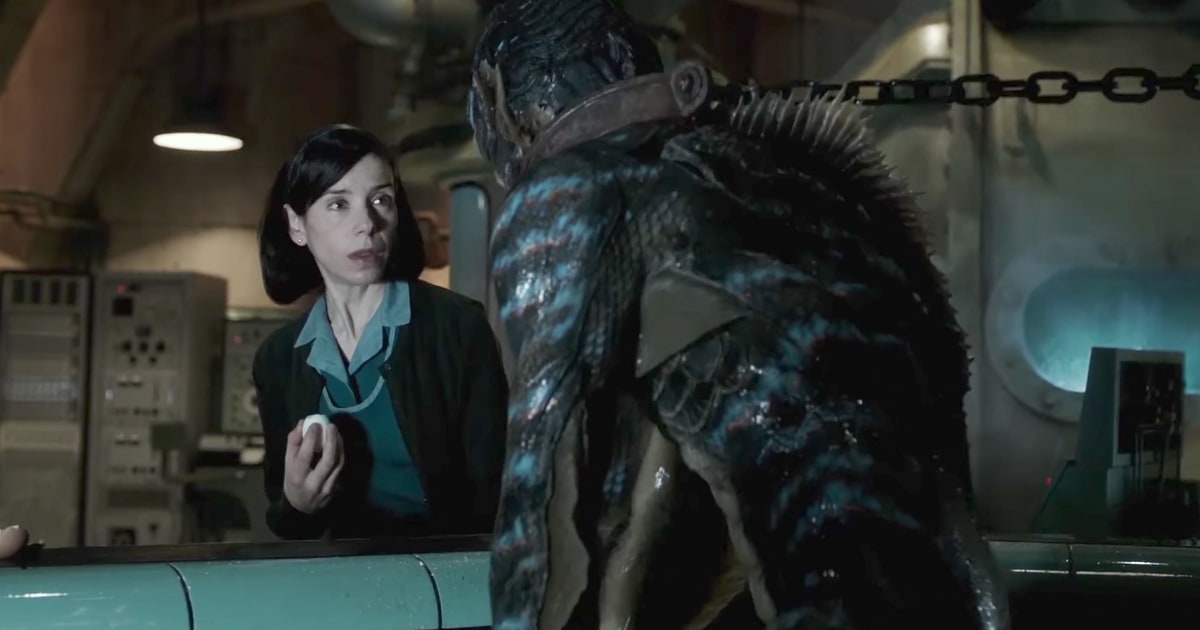
THE SHAPE OF WATER is without doubt the most beautiful film of the year. It's art direction is bright, detailed, and fantastic, and the score is a compelling mix of some French fantasy. Guillermo del Toro's latest film is perhaps his most ambitious, his most daring, but the ultimate message of the film left me feeling cold. Here is a love story that defies convention in every single way. I suppose appreciation here would depend on personal comfort.
Guillermo's films ("Pan's Labyrinth" as his most famous up until now) seem to explore "modern" fairy tales through a darker lens. We have heroes and villains, princes and princesses, monsters and duels. I think the appeal of a director like this is his unique take on visuals and design, and we surely can recognize any film helmed by him simply by the recognition of strong makeup and a tendency towards graphic violence. For "The Shape of Water," I appreciated this twist on a love story, set amidst 1960's Baltimore, but the film slowly begins to lose footing as it adds more drama and seeks to take greater risks.
Essentially we follow Elisa (Sally Hawkins), a mute woman who works as housekeeping in a top secret government agency. She works the night shift and falls into a familiar pattern of sleeping during the day, boiling eggs for "breakfast," taking a bath, and then taking a bus trip to work. She has friends who speak on her behalf: Zelda, a fellow maid (Octavia Spencer) and Giles, her gay neighbor with a flair for graphic design (Richard Jenkins). Our script rarely takes time to appreciate the fact that our heroine is voiceless, and thus we have simple silent moments filled with narration by these two to help explain plot and story points.
Essentially what happens is that Elisa meets "the asset;" a government-acquired aquatic monster that was captures somewhere in South America. It's basically the creature from the black lagoon with a few minor changes. What they see as a monster, Elisa sees as someone like her: mute, misunderstood, alone... She spends much of her time in the lab getting to know the thing, and little by little we are led to believe that they form some kind of mutual understanding. Our villain is Strickland (Michael Shannon), a vile contract worker who abuses the creature and hopes to cut it up to study its inner workings (as most villains do). Elisa works to hatch a plan to save the creature and set it free.
It's a story we have seen a million times before but rarely with this much craft put into it. I think we can almost lock up the Oscar for Art Direction with this film - it's honestly that good. There are a lot of films that this story reminded me of but none more than "Amelie," that charming french romance that used color, music, and sound to create another world. In fact, the first 20 minutes or so are so blatantly copied from that 2001 film that I wondered whether or not Elisa was going to break into Strickland's house to change his toothpaste for his foot cream.
The trailer shows you a lot about the look of this movie, but we are unprepared for the intensity of the 'romance' between girl and fish. I can appreciate the way Elisa begins to see the monster as an equal, but we are meant to believe that a lot of things are happening here, maybe a bit more than is comfortable. The creature is definitely man-like with defined features and two legs, but the sexual nature that grows between the two is something that went over my head. Maybe others will see it differently, I don't know. We never understand the creature as anything other than a misunderstood being that was kidnapped from another world. Adding sexuality to the mix just left things feeling a little out of place.
The ending is as you would expect from Guillermo del Toro, and in fact you may find many more similarities to "Pan's Labyrinth" than you might initially think. A couple things are very good here: the visuals, the makeup, Sally Hawkins, Octavia Spencer (a scene-stealer in every sense, although she seems to be typecast as a maid more often than is necessary), Michael Shannon, and an unexpected score from Alexandre Desplat. I don't think this is the best movie of the year, although critics certainly seem to think so. It all feels a bit forced, to be honest. That Elisa lives above a movie theater, that her and Giles will know choreographed tap dance numbers out of a hat, that everything follows such a predictable arch and then ends with a pretty bow on top. There's nothing bad with formula. I only wish "Shape of Water" could have been a bit more fluid with its creative license.
Sunday, December 3, 2017
The Disaster Artist (****1/2)
I forgot who said it, or where I heard it, but someone once said that they give every movie a standing ovation because they realized how hard it was to get made. A movie can be terrible or great, but at the very root of it, every movie is made out of passion. So goes THE DISASTER ARTIST, a modern-day "Ed Wood" that tackles the behind-the-scenes making of 2003's schlockfest "The Room," widely considered the worst movie ever made.
You almost need to see "The Room" before seeing this film. To understand the curious story here is to understand how baffling such a movie is in the first place. It's a story of betrayal, jealousy, drugs, football, and green screens galore. It's a movie about everything and nothing, directed and starring one of Hollywood's most baffling creatures: Tommy Wiseau (here played by James Franco (who also directs)). A lot happens in the film, but the reason so many people love "The Room" is because of the very strange way you can watch it over and over. A film can be bad (trust me, it is), but if you are compelled to rewatch it, is it terrible by definition?
The story here shows Wiseau's rise to fame with the help of his friend and costar Greg Sestero (Dave Franco). The two meet in a run-of-the-mill acting class in which Tommy shows no fear in performing a monologue from Streetcar Named Desire without any understanding of the material. Greg, a shy wannabe, sees Tommy as a man with no limits, no fears. They become friends and ultimately move to Los Angeles. Greg, a model with boyish looks, quickly finds a talent agency. Tommy, a man of nondescript age and nationality (his accent is charming and utterly impossible to try and imitate) has no luck in the acting gig. One director tells him he's better suited to play the villain, to which Tommy replies "I'm no villain. I hero. You villain!"
The idea is suddenly struck upon: the two men will write and direct their own movie. One of the film's running gags is Tommy's seemingly infinite amount of money. Wiseau famously self-funded the shooting of "The Room" back in 2003 to the tune of nearly $6 million, including promotion, premieres, and purchasing both a 35mm camera AND one in high definition. The production goes as one might expect. Tommy is unexperienced in screenwriting, in casting, in directing, and in comprehension (his first take on screen takes over 70 takes and the final delivery is shockingly bad). We assume people let him go along with it because of the paychecks. Besides that, no one would suspect "The Room" would ever be seen at all.
The film is based on Sestero's nonfiction account of his relationship with Wiseau and the filming of the movie. Wiseau himself has stated that this film is "99.9%" accurate in how it captures the behind-the-scenes aspects. We really only have one man to thank for that, and it's James Franco. The actor has been great (127 Hours) and bad (Oz), but here Franco is electrifyingly good as Wiseau. Hidden behind a false nose and that perfectly-realized accent, Franco paints a picture of this man who is two thirds clueless and one third heart. Yes it's a comedic role, but there is such a focus on the screen at every moment. We see the passion Franco has for his portrayal, which in turn helps us understand how such a terrible film was ever created to begin with. This is sure to be Franco's second Oscar nomination.
If you've seen "The Room" in theaters at midnight then you know how the audience will react. So they were with "The Disaster Artist." Fans will recognize so many subtle jokes and easter eggs regarding Wiseau, but those not familiar with the cult hit will surely still enjoy the film just as much. It's a love story about following your dreams no matter what cost. Despite an odd introduction (in which celebrities talk about "The Room" to the camera for a few minutes... It's a redundant moment - one celebrity says "I wish I could see what it was like to be on this film set!" but all we need to do it watch the film to find out) and a hilarious but strange conclusion (in which actual scenes from the 2003 film are played against recreations starring Franco and others), but overall this is without a doubt one of the most entertaining films of the year. "What a story, Mark!"
Saturday, December 2, 2017
Novitiate (**)
NOVITIATE doesn't know what kind of movie it wants to be. For first-time writer/director Margaret Betts, the results are anything but stellar. The story focuses around the Catholic Church in the 1960's and the consequences of Vatican II. The rulings uprooted the traditional cloistered nuns who were used to tradition and humility. Betts wants us to understand why those values were so important but misses the point on a very fundamental level.
The story focuses on a young nun named Cathleen Harris (Margaret Qualley) who is raised in a non-religious southern household but slowly finds God through her times at Catholic school. Her mother is convinced that her decision to become a nun is simply an act of rebellion. For Cathleen, those peaceful moments found in Church felt like a deeper calling, and so she knows that a devotion to God is her one true calling.
Cathleen moves into the secluded convent on the outsets of town, a convent in which nuns live a life of poverty and are not allowed to leave the grounds. Cathleen is one of many young, bright girls who enter the program. They are given the title "postulant" and are at the mercy of the Mother Superior (Melissa Leo), the fiercely strict nun who uses corporal punishment and mental abuse to shape these young girls into quiet women of grace and humility. When we see a nun in public, they are peaceful, calm, and holy. This movie would have us believe that they are brainwashed to be obedient at the risk of self-flagellation an banishment.
Where Cathleen is our traditional "heroine" (and though she is utterly forgettable in a quiet, unaffected performance), it is Melissa Leo's character that is meant to provide conflict and structure here. At first she receives the documents that illustrate the Vatican's changes to the Church. She refuses to share them with her girls, fearful of what those changes might bring. We see her take out her frustrations on the postulants, yelling, screaming, kicking, and the likes. Leo is the standout in this film, channeling a character like Fletcher from Whiplash to become a sadistic and vindictive leader. Her final scenes try to shed light on her sadness (in a tearful speech to her fellow nuns). At times the role is over the top, and she stops just short of physically chewing on the scenery to make her point. In a film so dull, though, I think Leo is the only aspect I will remember as vividly.
The film takes side turns into the emotional toils that novitiates and postulants face on their journey to marry God. Themes are hammered in with no subtlety whatsoever, and an obnoxious film score leaves no moment of silence to meditate. We feel the inexperienced hands of director Betts over this story, and yet I can admire her for the attempt. This film felt like a 5 hour snooze and yet when it ended I realized no more than 2 hours had passed. We never understand these girls, their motivations. In the end we get a title card that tells us how many nuns left the Church after Vatican II. That would arguably make for a much stronger film. What we have here is a rehash of your standard psychological thriller without any stakes or motives.
Subscribe to:
Posts (Atom)