OUR RATING SYSTEM
(*****) = do NOT miss! This one is as good as they come.
(****) = Fantastic - It's worth the price of the ticket (and then some).
(***) = Average - Nothing really bad, nothing really spectacular...
(**) = Perhaps you should find another movie to see.
(*) =
The bottom of the barrel. It would be hard to find something less entertaining or more unworthy of your time.


Maureen
(Mo) holds a PhD in marine geophysics (Dr. Maureen, to you) and works for the U.S. Geological Survey in Santa Cruz, CA. Maureen enjoys the outdoors (skiing, swimming, hiking, camping), dogs, cooking, singing, getting into (and out of) uncomfortable situations, and most importantly, watching quality movies. She makes a point of seeing as many Oscar-nominated films as possible each year and (correctly) predicting the winners. Her role on this blog is primarily as an advisor, collaborator, and "chime in"-er.

John (Jo) holds a Bachelor's Degree in Nursing, as well as a Bachelor of Arts degree in Film Studies. He currently lives in Chicago, Illinois and works as a nurse. His one true obsession in life is movies... The good, the bad, and everything in between. Other than that, he is busy caring for his cat, painting, writing, exploring Chicago, and debating on whether or not to worship Tilda Swinton as a deity. John is the master and commander and primary author of this blog.

Monday, January 26, 2015

Still Alice (****)

As the film comes to a close, the credits scroll past a ghostly image of the title "Still Alice" embedded on the screen, their appearance so dim that it's hard to even see them at all. The movie is quiet, beautiful, and oftentimes a wreck of emotion, but thinking about it the past night, I still have two thoughts that stick in my mind: the horrors of Alzheimer's disease, and the literal meaning of one's life. Without a mind, who are we?

'Still Alice' is based on a novel, presumably fiction, but the premise is so detailed and precise that there doesn't seem to be doubt that countless people have lived through nearly identical situations. We meet our heroine, Alice Howland, a doctor of linguistics and a professor at Columbia University. She is introduced before a lecture as being a world expert on language and development skills. On stage, she begins presenting her research on pronouns in regards to early child development. She loses her train of thought... There is a hesitation, and she laughs awkwardly as she tried to rediscover her ideas. "I guess I shouldn't have had that champagne," she said to the audience's laughter.

She returns home, a gorgeous brownstone that she shares with her us and (Alec Baldwin). On the outside, their life is everything we could dream of: Dream jobs, three grown kids, a solid marriage. Early in the film, Alice visits her youngest daughter, Lydia (Kristen Stewart), and like most moms would, tries to convince her to go to college in lieu of her acting dreams. Unlike her two other children, Alice sees Lydia throwing  away all her potential in search of something that may not come to fruition. Why can't she be more like her siblings?

The buildup to inciting actions are slight. Alice goes jogging and gets lost on her school's campus. She meets her son's girlfriend and introduces herself twice during the course of one evening. In another movie we might see the husband take notice and contact a doctor. Not so, Alice is resourceful and aware of her problems, and she begins seeing a neurologist to form a diagnosis: early-onset Alzheimer's. Yes she is younger than most sufferers of the disease, but it is possible. The condition also has a more rapid deterioration, and Alice becomes more prone to forgetfulness.

Her husband deals with it in stride. Her children, not so much. It is discovered that the disease is genetic and has potential to carry down child to child. Alice's oldest daughter shies away from discussion, and becomes defensive when Lydia tries talking to her mom about how she feels. Amongst her children, Lydia becomes the source of sanity as she and Alice have healthy conversations about side effects and how terrible it must be. Her other children back away into the shadows to become mere caricatures of what ones family shouldn't do in such a situation. For support, Lydia becomes Alice's go to companion. As her memories slip, it doesn't cause Alice to reconsider her daughter's acting choices, but as an audience member it sure does. If all we have are the moments we live, then why not do the things we love most?

Julianne Moore, of course, is our Alice, and her performance doesn't follow the typical course of dramatic performances. At the news of diagnosis, she is scared, nearly humiliated at having to tell her family and job about her problem. "I wish I had cancer," she says flatly in one scene, since those who suffer cancer are supported with pink ribbons and walks to the cure. Alzheimer's is simply a burden. Little by little, she disappears, and through good days and bad, she continues to deteriorate. Her performance is a revelation. What could have been a little-seen film is something that is nearly sure to win Moore her first (and well-earned) Oscar. She creates a real woman who by the end of the film can barely mumble, sits in a chair all day and stares at a blank TV. At her first diagnosis, she makes a list of questions (oldest child's name, home address, etc), questions that if she cannot answer would justify her ending her life. She continues checking her phone daily to make sure she knows the answers, but what she doesn't realize is that by the end, she will have forgotten what a phone is at all, let alone a question.

The deterioration of her mind is key, and the film chooses cinematic ways to portray her illness, from a literal lack of focus in the camera lens to jump cuts that span months. In that regard, we oftentimes are sympathetic to Alice's situation when she, for instance, wakes up in a new house wearing a bracelet marked "memory impaired." It takes a few minutes to realize she it simply vacationing at their beach house. At the films ending Alice recalls her mother and sister, both dead in a car crash from years ago. It's a rough, out of focus memory, and the film suddenly cuts to white. In a movie so full of emotional moments (having to wait while her daughter decides if it's okay for her to hold a newborn baby, or being unable to find her bathroom in her own home), the ending is all the sadder. In a life built on family and wealth and memories, the pain isn't seeing it come to an end, it is not having any resolution or closure before it is gone forever.

(Awards potential: Best Actress (Moore), Best Adapted Screenplay, Best Original Score)


Saturday, January 24, 2015

Cake (***)

We're not quite sure what Claire's deal is. She's crotchety, cantankerous, hobbles around with a bad back, and is addicted to pills. The film opens on a support group as they discuss a fellow member's recent suicide. While the other women are in shock and near tears, Claire asks about the logistics of the corpse traveling 2,000 miles on a flatbed truck before being discovered. Something is off with her, and the good part about 'Cake' is that the payoff is worth the wait.

Jennifer Aniston stars in what could be a loose sequel to her film 'The Good Girl,' in which she played a woman whose marriage was dissolving and her life was beginning to plateau. Like that film, 'Cake' picks up with Claire, this disturbed woman who has pill bottles hidden throughout her house and is distanced from everyone except her maid, Silvana (Adriana Barraza). We are not sure why she has such a nice house nor why she is so promiscuous, but that adds to the allure of her character.

The film has a few storylines, and perhaps some of the problems with the movie stem from these divides. We see Claire by herself; uncomfortable and more often than not, reclined. We see Claire with her maid, a Mexican woman who finds little merit in her boss's actions and yet finds deep sympathy to continue working for and protect her. We see Claire have fantasies about Nina, the woman who killed herself, visiting her in her sleep and working out some of her more deep-rooted emotional issues. Lastly, we see Claire as she meets and gets to know Nina's widower, Roy, and their son.

The story is entirely centered around this woman, and the film's intentions are good. Tonally, the audience could become lost, as we have scene after scene of abrupt 'visits' by Nina. Of course Claire is dreaming it, but how lazy does a screenwriter get to resort to a ghost to hit crucial plot points and character changes?

If nothing else, see this movie for our two female performances. Jennifer Aniston has never been better - a full-bodied acting job that slowly builds to a crescendo that is both powerful and true. From mannerisms to emotional content, Aniston is a breakaway star that was perhaps robbed of an Oscar nomination from actresses who gave more 'expected' performances (who? I shall not say...). Adriana Barraza ('Babel') is absolutely genius in a supporting performance that hits it out of the ballpark and perfectly compliments her costar. The chemistry these two have is beautiful, and their interactions are what made the movie watchable.

Looking at the overarching story of 'Cake,' there is not a lot of originality to be found, and in fact the movie searches for inspiration and so often comes up flat. That's not to say it's bad, but that's not to say it's amazing, either. For someone who has dealt with more drastic losses in their life, this film seems like it could ring true. For those who have faced addictions in the face and attempted to quit, then perhaps there is something to be found. To each their own, I suppose. Maybe I was just hoping for vanilla cake, and the movie turned out to be chocolate...

(Awards potential: Best Actress (Aniston), Best Supporting Actress (Barraza)

Monday, January 19, 2015

American Sniper (****)

Chris Kyle is credited with being "the most lethal sniper in US history" with 160 confirmed kills. He served 4 tours in Iraq only to be killed on his home soil by a veteran suffering post-traumatic stress. 'American Sniper' is one of Clint Eastwood's better films in the past few years, and it attempts to sort out the irony that last sentence, as well as our fascination with heaping praise on a man who is famous for killing a lot of people. Why have we come to glorify a man by calling him the "best sniper" in history? It's easy to read facts and statistics on paper, but to kill a man (no matter the reason) is another story, altogether.

The film opens on a tense scene. Kyle (Bradley Cooper) overlooks a convoy moving through a destroyed city. From his vantage point, he sees a potentially lethal situation: a mother and child hurrying towards the American soldiers armed with a bomb. The decision to fire is all his. Thoughts race through his mind, including that of his pregnant wife at home, the consequences of killing a child... The nature of this war, itself.

The drama then mellows, and we flash backwards to Kyle's childhood, conservative to say the least. He learns to never put his gun in the dirt while deer hunting, and his father teaches him the importance of protecting others. In church, he steals a small pocket-sized Bible. We learn very little about this boy besides the essentials, and in jumping ahead to his time as a bullrider and rugged cowboy, we wonder what has become of his life in the meantime.

Eastwood is a very skilled director and shows us the key elements of the story and exactly what the movie needs to carry an emotional weight. At the same time, this is an extremely brutal film, one that does not sugarcoat wartime violence nor glorify any aspects of war. One of the film's focuses is on the juxtaposition between Kyle's time at home versus his active duty. On the front, he is active, empowered, and close with his fellow soldiers. At home, he sits in silence and becomes distanced from his wife. The sound of a drill at a mechanics sends his mind racing with dark images. How any soldier can make the transition from two such extremes is amazing, and one that takes Kyle the course of the war to understand.

As an actor, Bradley Cooper has made quite a remarkable turnaround, going from Hollywood comedies to three-time Oscar nominee (in consecutive years, no less). With 'American Sniper,' he is at last a leading man. It is a very calculated performance that seems to come so effortlessly - fascinating to the point of being unnoticeable. Besides the physicality behind his appearance (allegedly gaining over 40 pounds of muscle), he is a man of few words and bottled emotions. Two scenes in particular highlight his mindset: one in which he sees a child pick up a bazooka and point it at a crowd, and one in which he takes a phone call in a bar. Obviously these are two moments in the film that couldn't be more different, but look at his reactions to the outcome of each. This isn't merely acting, rather a man who understands the consequences of all of his actions and the value of life, itself.

At times the story becomes burdened with a few cliches, ones that are easily forgivable. We see an enemy sniper (perhaps with Al Qaeda), one who's name becomes as legendary as Kyle's. He picks off Americans with stunning accuracy, and the final battle becomes a match between these two rivals. For a film so focused on dealing with the inner struggles of war, this 'good versus evil' take on the plot becomes almost trivial. The audience thinks our climax of the film is the final battle between these two men, but the real conclusion (and perhaps Eastwood hoped we would see) was the final shot of battle as Kyle leaves his weapon behind in the sand... For a movie so involved with a global war, it's hard to see that this is actually a very personal, quiet film; one of reverence and compassion.

(Awards potential: Best Picture, Best Director, Best Actor (Cooper), Best Supporting Actress (Miller), Best Adapted Screenplay, Best Editing, Best Cinematography, Best Sound Mixing, Best Sound Editing)

Saturday, January 17, 2015

Two Days, One Night (****1/2)

'Two Days, One Night' functions with little more than an idea: one woman's job depends upon the sympathy of her coworkers. Given a chance, would you forfeit your yearly bonus check in order to save a coworker from unemployment? It's an intriguing idea, one that seems to be a modern-day '12 Angry Men.'

We meet Sandra (Marion Cotillard), a mother of two who has recently overcome depression. She receives a phone call informing her that she has been made redundant at her job. She takes a few pills to numb the pain and hides the news from her children, but her husband is adamant: this is not the end. Sandra seems to have some support in her office, and they convince the boss to hold a recount of the results. On Monday morning, the staff will meet to decide whether or not they are willing to surrender their bonus. As the title suggests, Sandra has two days to meet 16 of her coworkers and attempt to reason with them. It's going to be a long weekend.

This is a film that at times falls into extreme repetition: Sandra journeys across the city, tells these coworkers she needs to keep her job, and listens to their response. In the hands of a lesser filmmaker such a story would fall apart. The beauty of the film is just that; the stunning moments that cushion the film and make it something truly great. We watch Sandra speak to a woman in the countryside who needs her bonus to build a new patio. The long take is beautifully framed as these two woman face each other, divided vertically by the corner of the home and shadows cast along their faces. Another moment sees Sandra climb several stories to an apartment due to power outage. Each visit is such a gamble for her, and the darkness is always closing in on her as she continues to battle her inner demons. The film is comprised of extremely long takes, one after the other, and with each new scene it becomes clear what a work of art this movie is - it's a careful balancing act that never loses its focus.

Marion Cotillard is stunning and carries the film singlehandedly. She is in nearly every moment of the film, and it's a wonder the Academy took so long to nominate her again for her continued commitment to excellence on screen. Compared to her previous roles, this is simply astonishing. Cotillard has come to be known for flashy performances and her portrayals of characters with great depth. Here, she is a simple woman who needs only to hold back tears long enough to make her point. We know she is on the bring of a breakdown, and her life literally hangs in the balance. There is never a 'false' moment in the film, and in fact it's quite a realistic depiction of a person going through trauma and mental fatigue.

The ending is perhaps a surprise to those who haven't read plot details, and the salvation found in Sandra's character is the crowning moment of such a beautiful film.  It's quiet, honest, and remarkable.

(Awards potential: Best Actress (Cotillard), Best Original Screenplay, Best Foreign Language Film)

Friday, January 16, 2015

State of the Oscar Race


With Oscar nominations officially out and several key awards already presented (The Golden Globes & Critics Choice), let's take a look at the current nominees in a few categories and attempt to figure out who may end up winning the Oscar. It's a boring year for the Academy, and several races already appear over - though the various snubs and inclusions we saw on nomination morning was more than enough to keep some of these categories exciting. 


BEST PICTURE

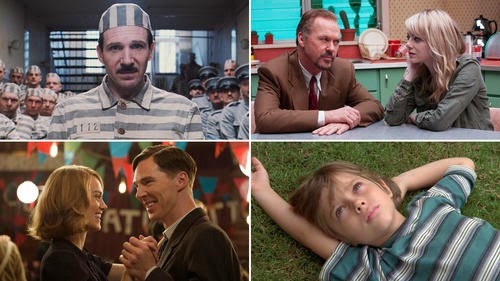
The first time since the race has expanded to 10 potential nominees that we have seen only 8 films nominated. The one film that could have been a surprise was American Sniper, but after seeing it nominated by both the Producer's & Director's Guild, this was to be expected. Notable snubs included Gone Girl, Nightcrawler, and Foxcatcher. Boyhood is essentially all locked up to win (especially since Birdman didn't get the all-important Best Editing nomination usually required of a Best Picture. The Imitation Game was one of the top-nominated films and on paper appears to be a strong contender. Upset to come? Selma received a major slap in the face, nominated only here and Best Original Song. Ouch. 

1. Boyhood
2. The Grand Budapest Hotel
3. Birdman
4. The Imitation Game
5. Whiplash
6. The Theory of Everything
7. American Sniper
8. Selma


BEST DIRECTOR

Again, the snub of Selma's director was somewhat of a shock, as was first-time director Damien Chazelle of Whiplash. Bennett Miller became the first person nominated for Best Director to not have directed a Best Picture nominee in almost 10 years, and the first time since the Best Picture race has been expanded. Richard Linklater is still the one to beat.

1. Richard Linklater (Boyhood)
2. Alejandro Gonzalez Inarritu (Birdman)
3. Wes Anderson (The Grand Budapest Hotel)
4. Morten Tyldum (The Imitation Game)
5. Bennett Miller (Foxcatcher)


BEST ACTOR

While both Eddie Redmayne and Michael Keaton won Golden Globes, Keaton also won the Critics Choice, oftentimes a telling sign of things to come. This has only ever been a 2-horse race, so upsets like the inclusion of Bradley Cooper seem only to spread the wealth. for now, bet on Keaton. 

1. Michael Keaton (Birdman)
2. Eddie Redmayne (The Theory of Everything)
3. Benedict Cumberbatch (The Imitation Game)
4. Bradley Cooper (American Sniper)
5. Steve Carell (Foxcatcher)


BEST ACTRESS

Yay, Marion! One of the year's biggest snubs was the omission of Jennifer Aniston in Lead Actress for Cake. It seems it was just too small of a movie, or perhaps voters simply like Marion Cotillard better, her first nomination since her Oscar win for La Vie En Rose. Julianne Moore has this wrapped up already, and there are no real challengers. 

1. Julianne Moore (Still Alice)
2. Felicity Jones (The Theory of Everything)
3. Reese Witherspoon (Wild)
4. Rosamund Pike (Gone Girl)
5. Marion Cotillard (Two Days, One Night)


BEST SUPPORTING ACTOR

The year's most boring acting race, with all nominees those we had expected to see. J.K. Simmons stands unopposed to his first Oscar win. 

1. JK Simmons (Whiplash)
2. Edward Norton (Birdman)
3. Mark Ruffalo (Foxcatcher)
4. Ethan Hawke (Boyhood)
5. Robert Duvall (The Judge)


BEST SUPPORTING ACTRESS

Another boring category all locked up. Laura Dern was the surprise on nomination morning, as she was essentially snubbed by almost every other award show and prize. Patricia Arquette has been winning a lot of trophies, and she is only building momentum. 

1. Patricia Arquette (Boyhood)
2. Emma Stone (Birdman)
3. Keira Knightly (The Imitation Game)
4. Meryl Streep (Into The Woods)
5. Laura Dern (Wild)


BEST ORIGINAL SCREENPLAY

This is an extremely difficult category, as the top 3 contenders for Best Picture share the same nomination here. Birdman won the Golden Globe race as well as Critic's Choice. Boyhood is the assumed Best Picture winner. Grand Budapest Hotel is a long-overdue potential win for Wes Anderson. Who will win??

1. Birdman
2. The Grand Budapest Hotel
3. Boyhood
4. Foxcatcher
5. Nightcrawler


BEST ADAPTED SCREENPLAY

Since all the Best Picture front-runners are original screenplays, this makes adapted a rather interesting category. Originally entered as an Original Screenplay, Academy voters saw it fit to move Whiplash to adapting (since it was based on a short film by the same director). At first it seemed like a bad idea, but looking at the competition, perhaps it's a blessing in disguise. Aside from The Imitation Game, Whiplash looks like it could win this award in a walk. 

1. Whiplash
2. The Imitation Game
3. The Theory of Everything
4. American Sniper
5. Inherent Vice


BEST ANIMATED FEATURE

In the snub of the year, The Lego Movie was omitted from this category. How is that even possible? What we are left with is a race with no clear frontrunner, aside from Dragon's recent win at the Golden Globes. This is anyone's guess. 

1. How To Train Your Dragon 2
2. Big Hero 6
3. The Tale of the Princess Kaguya
4. The Boxtrolls
5. Song of the Sea


As the month goes on, we will continue to break down the nominees and make sense of this year's race. Until then - get to the movies!