I think the reason I never could appreciate the original BLADE RUNNER (1982) was the simple fact that, despite its slow pace, there were few characters I actually rooted for. A movie can be long and "boring," but without sympathetic characters driving an actual plot, it's all for nothing. I knew BLADE RUNNER 2049 was going to be different right away, and I am beyond thrilled by the result, a movie that might eventually become regarded as better than the original. That rare sequel that improves on its predecessor.
We have many people to thank here, mainly our director, Denis Villeneuve. He has helmed great films (including last year's Arrival and my perennial favorite Sicario) and continues to make great leaps with consistently strong films and one of the sharpest eyes in all of Hollywood. Gathered around him is a solid team of writers, actors, composers, and the like. We feel the passion in this film and we can plainly see that everyone is giving it their best. 2049 may not be his best film, but Villeneuve has a track record that is intimidating to say the least.
Our story picks up several years after the original Blade Runner (which edit or version, I'm still not sure). Replicants are still being hunted, although the future economy has suffered a "blackout" in which large numbers of replicants died and data was lost. There is a brewing revolution that seems to be happening: the want for replicants to be identified as a unique species. They've made great leaps, afterall. Take Agent "K"(Ryan Gosling), a new blade runner who also happens to be a robot, himself. What a twist! Where the new prototypes have failsafe programming that allows them to be more human, they are still essential in hunting down the older generations who managed to slip away.
The movie is many things, but it is at its core a movie about identity. It's a modern-day Pinocchio in which we dabble with ideas of humanity, creation, and the definition of a soul. Times have changed in Los Angeles since the first film, but the mood is just as dreary and grim. K lives a solitary life in a tiny apartment, reporting to the police station with duty and yet is harassed by neighbors and other cops who have yet to accept a replicant as a fellow member of society. K pays little attention. His time is occupied with a hologram named Joi (Ana de Armas), a long-term girlfriend who lacks the ability to take solid form.
Like the original, we have a mystery. While hunting down a replicant at the start of the film, K finds a buried box in which a woman's remains are found. She died in childbirth, but that's not all. Without spoilers, the plot sees K working to find out this woman's identity and the whereabouts of her child. This child could very well change their society (for better or worse). Amidst the blackout, it is hard to find old birth records and the like, but K hears whispers of an ex-blade runner named Deckard, a cop whose whereabouts are now unknown...
The film is a marvel strictly on a technical level. I will be the first to admit that as gripping as this film is (during the entire 3-hour run time I sat in total attention) I found a large section of exposition to be utterly baffling. We meet Niander Wallace (Jared Leto), the founder of the company that creates replicants. He is simultaneously a villain and an enigma. We never understand his motives (and is he a robot, himself?). He speaks in long passages that sound good on paper but ultimately contribute little to the plot. He is balanced perfectly by a sidekick (Sylvia Hoeks), a terrifyingly-lethal replicant who is tasked with carrying out various hits and murders. The movie succeeds despite its cryptic feel, and I suspect multiple viewings might help with story clarity.
So much of the film's success is its nostalgia regarding the original. We have a Hans Zimmer score that echoes the synth-vibe or that classic work by Vangelis. The epic and dirty cityscape is just as we remember, and the flying cars have logically advanced a bit in the 30-years since we last saw them. Even the cinematography by the great Roger Deakins works at capturing that dreary, harsh feel we recall from the original. There are several moments of such inventiveness with the camerawork that you can't help but be amazed. The film is at times filmed in pitch dark, with only the slightest silhouette of a face to offer clarity. The soundtrack is brooding and epic. The costumes are iconic. And even yet there are two scenes that will knock your socks off: one in which K and his girlfriend make love (you will know when you see it. Never have I seen such a hypnotic or technically-brilliant section of filmmaking), and another in which Jared Leto and Harrison Ford have a quiet conversation underneath a shifting yellow light. Wow.
I would recommend 2049 to all lovers of film, and that includes those that had a dislike for the original. After all, I am in that company. What works in this latest installment is all the same fantastic elements from Ridley Scott's version I would argue that they are only improved upon. This is a movie you can watch on mute and marvel at the sheer beauty. You can also turn the volume up to high to hear an extremely sophisticated sound mix that captures the illusion of the future. Or listen to Harrison Ford's lines, delivered with as much heart and passion as the actor has ever given on screen. My point here is this: no matter what aspect you look at, this movie has it all.
OUR RATING SYSTEM
(*****) = do NOT miss! This one is as good as they come.
(****) = Fantastic - It's worth the price of the ticket (and then some).
(***) = Average - Nothing really bad, nothing really spectacular...
(**) = Perhaps you should find another movie to see.
(*) = The bottom of the barrel. It would be hard to find something less entertaining or more unworthy of your time.
John (Jo) holds a Bachelor's Degree in Nursing, as well as a Bachelor of Arts degree in Film Studies. He currently lives in Chicago, Illinois and works as a nurse. His one true obsession in life is movies... The good, the bad, and everything in between. Other than that, he is busy caring for his cat, painting, writing, exploring Chicago, and debating on whether or not to worship Tilda Swinton as a deity. John is the master and commander and primary author of this blog.
Saturday, October 14, 2017
Thursday, October 12, 2017
Lucky (**)
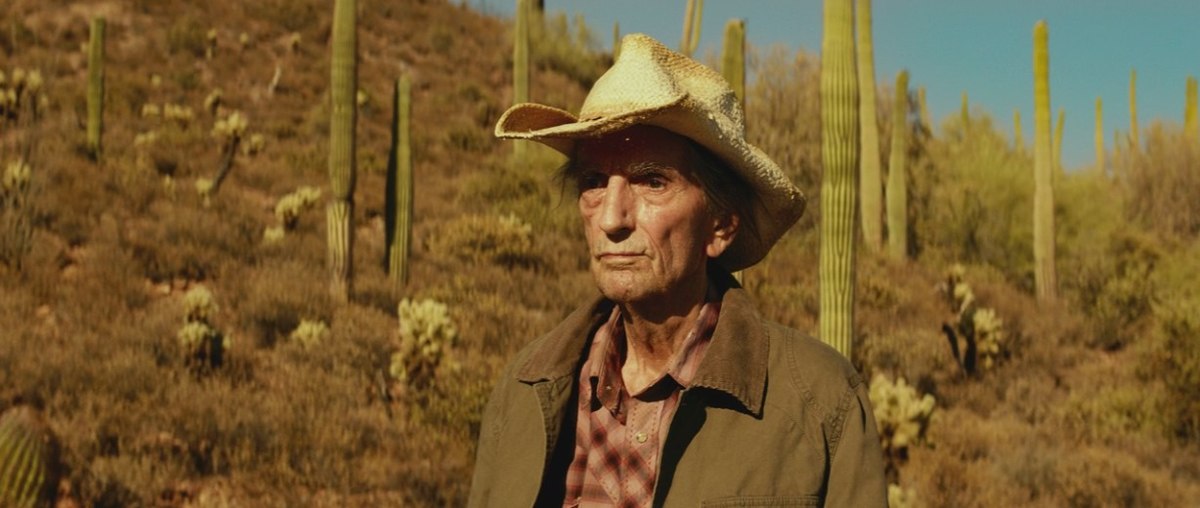
Only 2 critics had anything negative to say about LUCKY according to calculations at rottentomatoes.com. That's pretty astounding regard for a movie that I found to be perfectly vapid. John Caroll Lynch's directorial debut promised to be a swan song for Harry Dean Stanton, the regarded character actor who died earlier this year at the age of 91. How disappointed I was to leave the theater with such utter disregard.
The film follows a man named Lucky, a nonagenarian who wakes up to perform yoga, drinks a glass of milk, then wanders to the local diner to drink coffee and work on a crossword. After he comes home from an exhausting day, he watches gameshows and then drifts to bed. Fascinating. The next morning, what do you know? He does his yoga and drinks a glass of milk. Oh, I forgot, in the evenings he wanders to the local watering hole to have a bloody mary and enjoy conversations of folks with personalities as dry as the desert in which the story is set.
Not a whole lot happens in the film, which isn't too surprising considering how the film is setup. There is no drama, no action, no violence and barely any language (Lucky inexplicably yells "cunt!" several times at an unseen object that is later revealed in a confusing and odd reveal). I have seen many films that might be classified as "boring," but oftentimes those films are filled with beautiful words, remarkable scenes, and great actors in peak form. This is not one of those films.
Stanton made his mark in a great film called "Paris, Texas," another quiet movie in which a man wanders the desert. That film had style, heartbreak, and an astounding climactic monologue. I feel as though this story worked to echo such a story and yet hit nearly every mark on the way. This story isn't assembled with remarkable craft or an ear for dialogue. The camera work is unsteady and the assembly feels rough. Stanton, once a great actor, gives a fine performance despite the visible toll of old age. The rest of the cast has no such excuse. From David Lynch (who delivers not one but two bizarre monologues about a rogue tortoise (or was it a turtle?) to Tom Skerritt, every line delivered feels forced. The movie feels less like a major production and more like a student film that would have received a "C" grade with the following note from the professor: "there's something here, but I'm not sure what."
I realize how inexplicable it is to lambast such a critically-acclaimed film. It's so obvious after viewing the film that there's nothing to it. It's a vapid exercise that results in something that is more of a chore to sit through. The final film of Harry Dean Stanton definitely serves to be something emotional, but LUCKY as a whole is a remarkably flat thing that is not a movie I would expect to revisit any time soon.
Saturday, September 30, 2017
Kingsman: The Golden Circle (***)
KINGSMAN: THE GOLDEN CIRCLE is one of those movies I began to forget about the moment I left the theater. Writing this review two days later, I wonder if I even remember all the key set pieces and witty one liners. In the end I doubt it matters, because my initial reaction is still just as valid: this is a silly movie.
Kingsman follows up on the 2014 film that saw a reinvention of the James Bond character, this time with more language, violence, and sex. The sequel of course follows the normal route that all sequels have in Hollywood: more language, more violence, more sex. It makes sense. This film is less about the origins of a character than it is seeing how a secret organization works in full swing. The only problem is that the Kingsman are utterly annihilated within the first 30 minutes of the movie. Wiped off the face of the earth by an unknown villain, the British team (led by Taron Egerton) travel to the United States to meet up with Statesman (a country-style organization run by the most American man there is: Jeff Bridges. He's in all of 5 minutes of the movie, by the way).
Along the way, Eggsy (Egerton) run unto his old mentor, Hart (Colin Firth) who has had amnesia ever since being shot by Samuel L. Jackson in film #1. There are scenes that flashback to the original film, reminding us of what happened and why. There are also a smorgasbord of action scenes in quick succession that felt more like a seizure than a coherent plot. They travel the globe to discover our villain, Poppy (Julianne Moore), a quirky 1950's-diner-loving lady who camps out in South America and pushes her enemies into the meat grinder. She runs the largest drug cartel in the world and plans to kill everyone who takes these drugs unless her demands are met. Why all of her scenes are filmed in a Johnny Rocket's diner are bizarre. It's nothing compared to a musical prisoner she has kidnapped to perform for her (hint, it's Elton John). Scene after scene we see John prancing around the jungle wearing his 5" platform boots. It's silly, bizarre, and yet at times quite funny.
The movie is fine for what it is. It doesn't take itself too seriously, nor should it. The villainous plot is so baffling that you just have to sit back after a while and accept this movie for what it is. This is no James Bond, but neither is it Austin Powers. It's a hyper-charged array of zooms, tight close-ups, and bloody action. I didn't even mention Channing Tatum, Halle Berry, Mark Strong, Emily Watson, or Pedro Pascal, all sidekicks along the way with characters each zanier than the last. I am not a fan of action movies in general with few exceptions. "Kingsman" did little to sway my vote. At the same time, I had fun, despite a mind-numbing 2.5 hour run time. There are worse movies you could find yourself watching right now.
Saturday, September 16, 2017
Mother! (Mo****1/2 Jo**)
Mo (****1/2)
A true litmus test for the divisiveness of a story: Jo & I are very rarely in disagreement, and almost never (ever?) more than three stars removed on a rating. However, Darren Aronofky's latest head-scratcher, "Mother!" has served to fully and truly divide us. In reading the following, you will get the full spectrum of thought on this film, which is decidedly "love it" or "HATE IT". Surely, this will be the most polarizing film of the year, and perhaps one of the more divisive films of all time. Say what you will about it, I suppose, but everyone who has seen Mother! feels pretty strongly about it. Without having seen more than a teaser, I was intrigued, as we all were; but, I was even more intrigued after the film generated such strong reactions. And, after seeing it, I've even come out of hibernation to write about it.
Before I begin, I want to say: SPOILERS SPOILERS SPOILERS. You owe it to yourself to go into this one blind. I went in knowing a *little*, and maybe it helped, but it probably didn't. Nothing might have been better, but I'll never know. So I'm giving you a chance to leave now. Go. Shoo.
Ok, if you're still here, I hope you've seen the film. And if not, well, fine, be that way. Don't say I didn't warn you. Last chance - here goes...
Mother! opens in a quietly mysterious setting: a large run-down home in the countryside, not another person or structure in sight. A nameless couple (Jennifer Lawrence and Javier Bardem) live in the house - he a writer, she a fixer; she's working on renovating the entire house single-handedly. He's undergoing writer's block and is excited and inspired by some unexpected visitors - a man who is an apparent fan of his writing (Ed Harris), and later, the man's wife (Michelle Pfeiffer). Yes, they're invited to stay. Lawrence is not down - "they're strangers." Bardem says "they have nowhere to go." She concedes. The guests are intrusive, invasive, inconsiderate. They break Bardem's most prized possession, and have little sorrow about it.
So far, the film has Aronofsky's distinct look, complete with lots of hand-held, claustrophobic close-ups of Lawrence (who is spectacular, by the way), but we still don't really know where things are going, or what it all means. Later, our patience is rewarded when the stranger couple's two sons show up. They argue. The fight escalates. One son (played by Domnhall Gleeson, who is in the midst of yet another amazing year in his career) KILLS the other son. Wait, what!? What kind of story is this?? OHHHHH.... (*a light bulb*). This is Cain and Abel. Biblical allegory. Ok, I get it, kind of. Let's watch the film with that in mind, then...
Although, actually, I'll skip the rest of the plot, because it doesn't really matter from now on anyway (I'll get there). The allegories and layers of course cascade from here, the seed having been planted, and the metaphors become more and more obvious. The flood. Extinction. Immaculate Conception. The birth of the Son of God. The wise men. Forgiveness. Worship. You think back to the beginning: "Oh yeah, that was Adam and Eve! And the forbidden fruit! And the garden of Eden! ADAM'S RIB WAS TAKEN OUT AND THEN EVE SHOWS UP!"
Indeed, the parallels become so obvious that we're almost literally hammered in the face with them. At some point, well before the end, you're sure to say, "Ok, ok! I get it! It's the bible, ok! Do we really need to watch people ACTUALLY eat the body of Christ?" The final 10 minutes is a mess of violence, symbolism, and shocking imagery, all with direct parallels to Biblical stories. But you eventually realize: It's not just stories from the Bible. Bardem is God. Lawrence could be many things, but is most analogous to Mother Earth. She is the meek caretaker of the house, which is itself the living, breathing Earth. These people are destroying the Earth, and there's not much she can do about it. She can't even really fight back. These facts become so obvious that you'd have to be asleep to not notice - and I think, indeed, this is a primary reason that a lot of people checked out at this point, and why, therefore, a lot of people didn't like the film. "Why doesn't she just DO something?" "Wtf is up with her deadbeat husband!?" "None of these stories make sense strung together. What's the point?"
Does Aronofsky go too far? Maybe. Does all of it make sense? No. Do biblical allegories a good movie make? Absolutely not. But, I don't think this movie is about the bible. Like, at all. I think it's about many things, but three things most of all, from most to least obvious: the merciless and thoughtless destruction of the earth, the problem of religion, and ultimately, the relationship between the two.
Let's start with the earth, climate change being the most obvious parallel here, with its being obvious actually a critical part of the theme. This is the idea that smacks you in the face, harder and harder as the movie progresses, until we really don't want to watch it anymore, either because it's hard to watch or because seriously, we get it already, stop. I think the (lack of) subtlety is one hundred thousand percent intentional, and not only that, I think it's important that it's presented this way. It's almost like we, as a population, are complete idiots for not noticing this happening, right in front of our faces, in real life. After all, when we shrink climate change down to the size of a house, it looks pretty darn terrible. Putting this relatively abstract notion ("it's below zero out - how is the earth warming?!") into a setting that we can all understand ("I just fixed that! Don't touch it!"), and then on top of it, making it over the top and horrifying... It emphasizes the obviousness of what is happening all around us, what our role is in it, and how utterly fixable some of this stuff is ("Just don't sit on the counter. Please."). Smaller themes become clear, particularly in the final moments: Mother tries fighting back. Is this a natural disaster? There are too many people in the house. Overpopulation? Stealing from the home. Using up all of the natural resources? But again, these little parallels aren't the important thing - the important thing is that the parallels are OBVIOUS.
The next theme is the problem of religion. If I had to pick, this might be the reason that I like the movie so much. Very obviously, the film is filled with religious symbolism and allegories. An endless amount of them. I keep thinking of more, two days later. But once again, that's not the point! He tricked us again! As an aggregate, these metaphors paint a picture of God and of organized religion. And, you may have noticed, the film really does not paint a very favorable portrait of God, or of religion. There's even a fair amount of satanic imagery around Bardem. Bardem's character is not a hero. He is, in fact, pretty one-dimensional - all he cares about is receiving praise for his work; indeed, he seeks this to the utter destruction of anything and everything else ("Oh, you killed my son? That's fine. I understand. I know you did it because you love me."). That is the very DEFINITION of one-dimensional. But again, I think THAT is actually the important thing here. Once again, when God (and indeed, some of these biblical stories) are thrust into a real-world setting, we can finally see Him for what He really is - selfish. Forgiving, yes, but ultimately self-serving. Now, I'm not here to comment on whether there is a God, or what His/Her/Their/Its personality may be like, or whatever, but in any case, I think this is a fascinating commentary on the idea of God, how people see Him, and ultimately, the utter ridiculousness of the mental hoops you have to jump through to justify classical Christian beliefs (as emphasized by the numerous outrageous allegories in the film, e.g. Cain and Abel). I think that yet another reason people may not have liked this movie is because the portrayal of God and religion is so unfavorable. Religion is very personal to many; it's a sensitive topic and easy to offend when discussed. But though I might not personally agree with the details of the portrayal shown here, I find the implications here endlessly fascinating.
Ok, so finally, the last theme: how religion/God and climate change are related. Why have all this religious symbolism if all you're going to do is talk about climate change? And how religion can be harmful to climate change? Well, once again... isn't it a bit obvious? The people make God who He is. Without the people, God and Mother would probably be pretty happy... we get glimpses of this at the beginning and through a central stretch of the film. It's the people that make Him into a monster. It's the people that destroy the Earth. It's the Christians that are destorying the Earth, and God is letting them because He is being worshipped in the process. The people could care less about the house, or about Lawrence. They're there for Bardem, to worship and praise him, at whatever expense. Once again, we're shown this in an over-the-top fashion, almost as if to say: Look what you're doing! Seriously, look around for one second! Isn't it obvious how awful this is? Almost, as if we should be looking around and questioning our actions in our own real lives. Almost.
So, sorry not sorry for the novel. If you've seen the movie, maybe this will change your perspective, but I doubt it. I suspect it's kind of like trying to convince someone that they're wrong about their religion. And I really don't think it's ok to convince someone they're wrong about their religion, so of course, you can continue to think whatever you'd like about Mother!. Though perhaps by reading this, you'll go around and just be a smidge more observant and considerate of your surroundings, which is, after all, what Aronofsky was going for in making this film... I think. Right?
Jo (**)
Darren Aronofsky is surely a skilled filmmaker. He made what I thought to be the best movie of 2008 (The Wrestler) and then came back to shock and delight with Black Swan a few years later. His films have style and a raw viscosity to them. They play out in claustrophobic closeups and a shaky cam that convinces us of the setting. That is all present in his latest headscratcher, MOTHER!, a movie with seemingly vast ambitions and little interest in telling a cohesive, tangible story. This is style over substance.
We meet the characters of Him (Javier Bardem) and Mother (Jennifer Lawrence), an odd married couple that lives in a remote field and works slowly at renovating this grand home. Lawrence works on painting, spackling, designing, and building, while Bardem is tediously trying to work on his writing. A man visits the home (Ed Harris), a self-professed fan of Bardem's writing. He is invited to spend the night. Odd. The next morning, his wife (Michelle Pfeiffer) pays a visit. Then their sons. Bardem is welcoming of any people who want to offer him praise. Lawrence is thinking the logical thoughts, mainly "what?" "who?" "why?" "excuse me?" and "stay off the furniture."
That's the story we were shown in the trailer. Okay, sounds good. We heard this might be a soft reworking of the classic "Rosemary's Baby," and there are certainly elements that play off the paranoia and occult. The suspicions begin early on for Mother, who is curious about her husband's intense fascination with these visitors, and then equally puzzled by a newfound tunnel in her basement and a beating heart behind the walls. Where "Rosemary's Baby" worked on a slow build that ended in a shocking climax, Aronofsky doesn't have the patience or belief in suspense.
Something happens in the last third of this picture that throws the entire story off its axis. Mother is pregnant, and as she and hubbie sit down to a freshly-cooked dinner to celebrate, there's a knock at the door. Then another. Then another. Pretty soon their home seems like a frat party during Homecoming and their house is thrust into a state of panic, shock, and the like. We meet new characters. Things happen. A lot of things. What exactly I don't know. What began as an intimate thriller divulges into something that more closely resembles a nightmare of Charlie Kauffman. It's a complete wash of disorder and incoherence. Of course many are drawing religious parallels and feel smart for doing so. "Obviously this is a reference to Cain and Abel." "It's about Mother Earth." Perhaps this makes some people feel smart. For me, this was an assault on the senses.
The film carries the director's distinct look. There is a strong flow and style to the work. Does the story hold water on its own? I don't think so. Lawrence and Bardem do what they can with the work, but there have been interviews by all 4 of the main cast members where they admit to not understanding the idea behind the very movie they star in. I can't blame them. This is a movie that is surely ambitious but ultimately falls flat. Not only can I understand the motivations of any of our 'heroes,' but the cyclical conclusion feels like another effort to present profoundness when there is none. Some feel like this is a movie that is made for repeated viewings, guessing at the symbolism and spokem words for years to come. Don't waste your time. You'll be scratching your head for so long that your hair might fall out.
Sunday, September 10, 2017
Columbus (****1/2)
A movie about architecture shouldn't be inherently entertaining. The thing about the design of a structure is that it's appeal is completely up to the beholder, if anything. Despite this, here I find myself floored at a directorial debut that is in every way a precise stroke of control. In every way this movie seems as though it should have been corny, and yet the assuredness of the director leads me to believe that there is no wasted moment, no shot too long, no word misspoke.
The movie begins with a sequence in which an elderly architect collapses. His assistant (Parker Posey) accompanies him around a famed Columbus-based home, and she spends the majority of the scene trying to track him down in the immense estate. Shot by shot, it's quite literally a perfect sequence. We cut to a couple parallel stories, one following an aspiring librarian named Casey (Haley Lu Richardson) and the architect's son, Jin (John Cho) who has just flown in from Seoul to be with his sick parent. The opening of the film cuts back and forth between these two, ever so slowly, with no clear connection. Jin spends much of his time wandering a fancy yet isolate hotel, while Casey cooks dinner with her mom and dodges the advances of her esteemed and charming coworker (Rory Culkin).
The film is not as much about the circumstances of their meeting (a beautiful scene in which they walk down a long iron fence and then finally meet at the gate's opening) but about the conversations they share, largely based around Casey's love of the city's architecture. She recognizes Jin's father and had planned on seeing him in a now-cancelled lecture. To her surprise, Jin finds no interest in the appeal of buildings, so he has her describe some of her favorites. Along the way, they discuss their dreams, their setbacks, and perhaps identify the damaged parts of themselves that they wouldn't otherwise be able to see. The film's most beautiful scene comes when Casey is forced to tell Jin why she loves a particular building, and not for the reasons she might have learned on a guided tour. We watch her smile and tell Jin with such a warmth about this converted bank, and yet we hear nothing she says through the glass windows. We don't hear her insights, but that doesn't mean we don't understand every single word she is saying. Watch her light up.
2017 has been an odd year for movies so far. Nothing special overall, nothing overreaching or important. Out of all of them, perhaps COLUMBUS is the quietest movie I have seen. It moves at a glacial pace while we slowly learn about these two people, each in their own way lost in a city that has completely different meanings to the other. It's largely due to the impressive debut of a director named Kogonada, a man who understands how to frame a shot, how to direct young people, how to interpret a script, and how to make visual poetry. For a movie set in a random midwest city, believe me when I say that watching this film I felt as though I were in Wonderland. Each new structure and glass and straight line created a scene so absolutely lovely that it's absolutely amazing to think that such a place exists in the heartland of the United States.
You would be hard pressed to find a movie that more accurately depicts kindred spirits. We grow to like Casey and Jin ever so slowly that by the end it's amazing that such an emotional climax had been built up at all. The same goes for a script so charming in its simplicity that it's refreshing to just sit back and watch it unfold. Listen to how Jin talks about his Korean background, and then listen to Casey slink around discussing her mother's history of addiction. These aren't high points in drama. They're simply another topic that is brought up. Nothing is spelled out for us. That's life, I suppose.
Subscribe to:
Posts (Atom)